The legal foundation of net-based art
Dear Ursula,
quite some time has elapsed since our last blog entry.
Over the last months, I have been reflecting quite a lot about the actual CONDITIONS of net-based art creation, such as funding, the technological architecture of the medium and then, most interesting to me: the legal basis of online art.
I organised an
Upgrade! Event on the beginning of June, which focused on the concept of unrestrained sharing and free culture. Together with the
Transmediale festival, we have invited the Spanish activist group
eXgae to give a workshop and a film screening of their outstanding annual event
The Oxcars.
The preparation of this workshop inspired me to do a research on the topic, which I want to share with you. And then of course I have some specific questions about copyright and sharing for you and I am curious to hear your position as an artist.
Internet law is created by courts around the world right now. The commissions who work on the subject must do their best to derive the solution of legal disputes in the net from preexisting jurisdiction frameworks. This whole process is still in the making and until now the leading principles of intellectual property and commerce in the net are in a state of constant revision.
These issues are essential for everyone in the media art field, as future decisions might directly affect the work of artistic and cultural practitioners. This starts with service provider liability, copyright, commerce guidelines, content restrictions and ends with web site development legal issues in general. However, most people I know are generally not or only very little informed about the current development in this field.
What’s the situation in the U.S.? Is this discussed more often in your country?
"There has never been a time in history when more of our 'culture' was as 'owned' as it is now. And yet there has never been a time when the concentration of power to control the uses of culture has been as unquestioningly accepted as it is now," writes
Lawrence Lessig in his famous book "Free Culture: How Big Media Uses Technology and the Law to Lock Down Culture and Control Creativity (2004)". The book is also available as a free online audio book here:
http://www.archive.org/details/free-culture-audiobookI think this statement by Lessig is really crucial not only for our work, but practically for everybody who uses the web as a resource for knowledge and contents of any kind. What do we have to know when we upload data or take contents from the web? What are our actual "rights" when we call ourselves "right owners"? Which instruments can we use as an alternative to proprietary software? Here is just a brief overview of possible sources which might be helpful in finding answers:
The Creative Commons"The
Creative Commons project was founded in 2001. In December 2002, Creative Commons released its first set of
copyright licenses for free to the public. Creative Commons developed its licenses - inspired in part by the
Free Software Foundation’s GNU General Public License (GNU GPL) — alongside a Web application platform to help you license your works freely for certain uses, on certain conditions; or dedicate your works to the public domain"(
www.creativecommons.org)
Free Software Movement"Free software or software libre is software that can be used, studied, and modified without restriction, and which can be copied and redistributed in modified or unmodified form either without restriction, or with minimal restrictions only to ensure that further recipients can also do these things and that manufacturers of consumer-facing hardware allow user modifications to their hardware. Free software is available gratis (free of charge) in most cases.” Richard Stallmann started the free software movement in 1983 with the aim to satisfy the need for and to give the benefit of "software freedom" to computer users."
(source:
Wikipedia / http://en.wikipedia.org/wiki/Free_software).
There is quite a number of collectives and groups who produce free software for various kinds of artistic use, such as:
GO TO 10 (a collective of international artists and programmers, dedicated to Free/Libre/Open Source Software (FLOSS) and digital arts):
http://www.goto10.org, or
Blender (a 3D graphics application released as free software under the GNU General Public License):
http://www.blender.org/
FLOSS manuals: they make free software more accessible by providing clear documentation that accurately explains their purpose and use):
http://en.flossmanuals.netdyne.org: an independent software ateliert which provides free software for artistic use):
http://www.dyne.orgFor everybody who like to take found footage from the web and (re)use or sample it for their own artistic work, there are some really interesting free content databases for music and video:
http://www.netaudioberlin.dehttp://www.starfrosch.chhttp://www.orange.at/Content.Node/http://www.vdb.org/Quite a number of artists is focussing on this topic as part of their artistic practice, for example the open music video project "music from the masses" by
Matthias Fritsch / Germany. You can watch it directly at YouTube:
http://www.youtube.com/watch?v=GxNaN79qsxUOr the
"copy it right-project", which was initiated by
Phil Morton, now continued by
jonCates / Chicago.
Phil Morton stated:
"First, it’s okay to copy! Believe in the process of copying as much as you can; with all your heart is a good place to start - get into it as straight and honestly as possible. Copying is as good (I think better from this vector-view) as any other way of getting ‘there." Read the whole manifesto here:
http://criticalartware.net/rsrc/dwnl/dS_DISTREL.dwnl/www_VR/COPY-IT-RIGHT suggests that the availability of resources is, as jonCates puts it,
"not simply for study, but also for creative cultural uses by artists." More infos here:
http://www.furtherfield.org/displayreview.php?review_id=335But it's not just the artworld who deals with these topics: also the academia around the world starts to shift their attention to digital rights. The
CC Monitor project for instance is an ever-growing online platform, which contains "automatically collected data, graphs, research and collectively written commentary on the global adoption of Creative Common licenses." The aim of the project is to establish a "valuable online resource for the Creative Commons community, for researchers, the press, and other third parties."
(http://monitor.creativecommons.org/Main_Page)On July 14th 2009, the initiator of CC Monitor,
Giorgos Cheliotis, held an intersting lecture at Harvard University:
Mapping the Global Commons: A Quantitative Perspective on Free Cultural Practice. More infos here:
http://cyber.law.harvard.edu/events/luncheon/2009/07/cheliotisHere are some of his key questions:
Where in the world are people using Creative Commons licenses? How much content is licensed under Creative Commons and what are the individual, social and cultural factors that influence adoption? Also, what happens after content is made available for remixing under an open license? What kind of ‘cultural flows’ emerge from ad-hoc, large-scale remixing activity and how do these vary under different incentives for production? I would be especially interested to hear more about the cultural flows which evolve out of remixing and reusing. I am not sure how much research has been done on this field so far, but I certainly think that this is a great topic for the cultural studies.
Since I wrote about art and science now, I would like to get back to the political dimension of this topic. Did you hear about the
Pirate Party in more than 30 European countries? The Pirate Party wants to fundamentally reform copyright law, get rid of the patent system, and ensure that citizens' rights to privacy are respected. The party was founded by
Rickard Falkvinge in Sweden in 2006 and since then spread out all over Europe. Since June 2009 the German pirate party even holds one parliament seat!
Is there anything similar going on in the U.S.?
If we consider all this, it gets clear that the place where net-based art actually resides is in a state of constant change. There is an increasing need for artists and curators to get more aware of the legal foundation of online plattforms and also about our rights. As a curator, I am asking myself: If I would exhibit a participatory work, say your
HTML movement library, how can I make sure that the audience does not change, alter or manipulate your work without permission and do I maybe need an official permission to present such works in public? Honestly, I have no idea about that.
What I would like to hear from you, Ursula: it is quite a common assumption, that net art is based on a tradition of sharing and remixing. What is your opinion on that? Do you want others to re-use your work? If so, under what conditions? Have you ever published one of your works under a Creative Commons Licence?
Questions over questions here ;-)
At the end, I want to share a real inspiring movie about the first festival of free culture in Barcelona:
The oXcars!Have fun and I am looking forward to hearing from you!
Greetings from Berlin,
Ela
Enacting the Internet
Dear Ela,
Thank you for your detailed description of our collaborative Blog/Theater piece "
tabootheater 2.0" in Zürich! Now that several months have past since then, it is possible to step back, rethink and "relive" the experience. It was indeed a new way of working – to meet mostly online to prepare, discuss, and plan for the piece - and it showed that one can have inspiring communication on a virtual drafting board, create so to say a mental and virtual space for the piece before giving it its physical shape on location. To work with participants online and on location and let both worlds merge together right on stage was also unique indeed...
I always enjoy and I am always excited to find out more about the peculiarities happening in a confrontation of "real" space with the Internet, as this is the main topic in all of my work. How to fill an exhibition space or a theater space with Internet/Web-inherent qualities, or more: How to make the Web visible in physical space. How to feel/act/touch the Web!
This brings me to a topic, which we both recently addressed, in a dialogue we were invited to contribute for "
Curediting–Translational Online Work", a new project by CONT3XT.NET, at Vague Terrain, the online journal for digital art/culture/technology. In our
thoughts, which we let grow by emailing them back and forth a couple of times, we ended up addressing this topic: Curating as a performative event. And this describes pretty much what our experience in the theater was like: Organizing, directing, inviting, and redesigning the online Blog into a participatory intervention on stage.
By the way, the whole series of essays in Curediting – fourteen different approaches to this topic submitted by different artists and curators – is an amazing read!
One of the thoughts weaving through our dialogue was also – once again – the definitions of art on the Internet, net art, new media art, etc. Where and what each is. The easiest approach for me to define this, is to start describing my own work. My oeuvre includes net art - which is purely net-based work. And then there is "Web-driven" work. This is my favorite way of describing the work that expands from the Web into space while the Web is the "motor" – its properties, its code, and its architecture are coming to live in different media such as digital imagery, video, sound, text, performance and (physical) movement, and even fabric.
A brief moment of self-promotion: My performance series Website Impersonation carries out exactly this multi-layered structure of embodying the Web. Through the ongoing participatory project "
html-movement-library" and through the source code of the website which drives it all: the sound we hear is html, the visuals we experience are html, and the movements that are carried out by performers are html. I will be showing a new part of the series in Vienna this December. I will share more about it then...
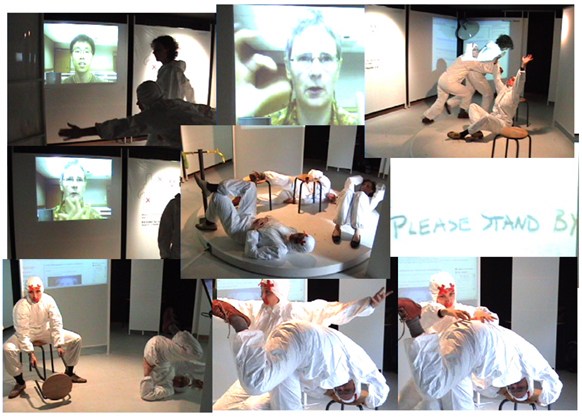
I also would like to answer your questions about my experience in regard to the live online pieces at the Theater in Zürich. It was hilarious and thought-stimulating to perform a live-web piece with
Antoinette Lafarge and her students. They arrived at the performance space via video-skype, joining our event as the "Universal Translation Service" with their motto: "Our goal is perfection. We translate all languages with 100 percent accuracy, guaranteed".
The "translator" appearing on screen never seem to be the person we heard speaking, there was always a moment of a strange "disconnect" between the words, the texts, and the speakers. A definite play on how identity online still can trick us, and how the info we want is often not the info we get...
A (theatrical) role that the three organizers of the whole Internet/Theatre event - Anke Zimmermann, you, and me - also had, was to be a sort of Blog-Protocol Impersonation, or let's call it, the incarnation of the Blog-mechanism. While definitely resembling the three creatures in the logo of the piece, we, for instance, reacted with "mechanical work" on stage to the above mentioned translation efforts. And while they switched from one translator to the next, we changed the scenery by turing the revolving stage, scrolling from one entry to the next. In between we also commented on their performance, in a way only uncontrollable tabooblog-incarnations are allowed to behave... :-)
Scenes from the online/live performance "'Universal Translation Service' meets the Blog-Mechanism-Incarnations" in tabootheater 2.0.
This was also our real role in the theater event. We "turned the stage", decided when and which events took place; we organized, and somehow "directed" our participants, etc. So, clearly, our theatrical characters were a metaphor of showing our role as organizers of the whole event – in becoming the "protocols" and "mechanisms" of the blogs' organizational structure in space.
Wrapping up my entry, here is my closing thought/question - bringing up something totally different:
The new size of New Media Festivals.
It seems all festivals became larger lately, including as many sub-shows, threads, ideas, artists as possible. I heard and read this about this years ISEA in Singapore. Not to criticize this show in particular - I wasn't there to experience it - but it seems that New Media festivals in general become in themselves more and more a physical translation of the Internet. Sounds like a great plan, in the same time, it seem impossible for the visitor to see everything. As, on the Web, one picks, searches, bookmarks what one likes, one can only go through as much content as humanly possible. Maybe festivals are not meant to invite their audience to see everything any more, but more to show the diversity that's out there, the same notion the Web brought to us - a possibility of choice.
I'd be interested in your thougths about this and, also, about the emergence of so many new New Media festivals in the last years, and so I'd like to ask you about your experience with festivals in general...
And on that note, I'd like to hear from your visits to Ars Electronica, and your contribution to the Upgrade! Festival in Skopje...
Many warm autumn greetings from New York,
Ursula
Netart in the theater
Dear Ursula,
it has been a while since we have last posted an entry in our blog.
I want to take this opportunity to write a bit about the experiences of our latest collaboration "How much taboo does art need?" - an internet theater project for the Theater am Neumarkt in Zurich / May 2008:
http://85.214.107.190/zblog/We have been working on this project for more than a year. Due to the fact, that Anke, you and myself live in different parts of the world, we managed all the preparation work during regular skype conferences. This was really a unique experience, and I am suprised how productive this has been.
Our main idea was to transform a blog and its contents into a theater space - both in spatial structure and contentwise. We have launched the taboo blog by the end of 2007 and started to collect materials, comments and questions related to the topic "how much taboo does art need?"
By the beginning of May, we came together in Zurich at the Theater am Neumarkt and worked on the transformation of the theater space and the technology which we needed for the project.
May 19 was the beginning of two workshop sequences, during which the contents of this blog got staged in the real (theatre) space. We have invited different acteurs from the international theatre and art scene to work on the blog material with us: artists, theorists, dramatists, directors, stage designers, performers or curators.
On Saturday, the 24th, we have presented the various artistic approaches, which resulted from the workshops, in the form of a walkable installation and a live-performance. International artists and art professionals participated via skype, commented on the events and talked about their own experiences about art and taboo.
We have been particularly interested in the individual approaches towards the blog material.
And of course we wanted to find answers to the question: To what extend does the internet affect or alter the way we communicate? How does this influence the contemporary theatre?
So, what are the results of this experiment?
First of all, I have to say that it was just great to really experience the representation of the blog in the real theater space. Thanks to your wonderful space design concept (and the creativity of the stage designer Barbara Pulli) we have managed to give people an idea of how a blog actually works and what its dramaturgical structures are. I especially loved the shoutbox, a megaphon which automatically transformed the blog's shoutbox entries into speech - like that, people from all over the world could state their comments, audible for everybody in the theater space.
Most of our workshop participants took full advantage of the possibilities we have prepared in the space: the revolving stage for live acts, the video workstation, the text station, the shoutbox and the audio editing suite. For me it was extremely interesting to see the individual approaches towards the topic taboo, but also towards the space and the blog itself. The workshop groups have been heterogenous, some people who hardly ever use the internet, and others who have based their work on digital media.
As you can imagine, this led to a broad range of results - from audio files, to movies, objects, web conferences, theoretical work and live acts. However, I must say that we haven't focused so much on the results, but rather on the process itself. The involvement of different professions and backgrounds into a theatrical process, the way how technology challenged ways of communication and collaboration.
And there was this constant question of how to best mediate this process to the outside world (which is an all-time favourite question in this blog, by the way ;-)
And here, you and I had to experiment on a day-to-day basis. I think in the end we have found the right balance between involving ourselves without acting too much as a guide or director. But this took some time, I have to admit. In the beginning, I was kind of overwhelmed by the dynamics of the workshops and the presentation. But, that's the risk (and the beauty!) of a laboratory situation.
"Mediating this process to the outside world" - this does not only mean to the visitors in the actual space, but also to our online audience. This was to me one of the biggest challenges - to be present both in the real and the digital space. (And this led to strange and funny situations, especially when I think of our live streaming experiments or the skype interviews ;-)
Here it would be interesting if you could talk a bit about the live / online performance that you have organised together with
Antoinette LaFarge and students from the University of California. This was an experiment on artistic collaborations over the net and I thought it would be worthwhile to follow up on these kinds of outputs, as they open new spaces for thoughts.
What I also think is important: despite the fact that the internet as a mass medium has been around for more than 10 years now, there is still a huge gap between online art and the classical notion of theater. And in a way I see that both concepts contradict each other: the internet as a "spaceless space" with a "timeless time" (Manuel Castells) and the theater, which is all rooted in the presence in time and space. Nevertheless, I believe that it is extremely interesting to place both art forms next to each other to see what their specific qualities are and to what extend they can inspire each other.
Ursula, it would be great to hear your thoughts on that.
Best regards from Berlin,
Ela
The rise of the net art market...
Dear Ela,
Thank you for your thougths about the Transmediale. I really appreciate it, as I wasn't able to come to Berlin and see it. As a matter of fact for the last few months I have been immersed into the production of my own work for several upcoming shows and projects – I just gave three new performances (of my "Website Impersonations: The Ten Most Visited" series) here in New York – and, there will also be new work to see in Europe! I am actually looking forward to digest, take time to think through, and share with you all the feedback I have received so far to my new work... but that's for another time...
This work mode of mine has made it quite difficult to let me step away from it (I love it though, don't get me wrong!) and go and "physically" see other shows... So I have been at least trying to follow shows and blogs and lists online to see what else is going on...
A very passionate discussion has developed on
rhizome's discussion list about a show that is about to open tonight at the
iMAL Center for Digital Cultures and Technology in Brussels. "Holy Fire. Art of the Digital Age", curated by Yves Bernard and Domenico Quaranta, featuring New Media artists, who show their work in galleries and/or whose work is part of collections around the globe. (The show also runs during Art Brussels.)
What an engaging idea to address the question of net art and New Media Art, and its stand in the art market, in a show! And, also, to ask the question of how and what to collect when collecting New Media Art. A topic we came across several times in our discussion, Ela!?
Fascinating, that the announcement and press release of this exhibition has already triggered a fiery discussion online before the show has even opened! So we are having a hot topic here!
While reading through quite a lot of the above mentioned discussion thread I noticed several times statements of how weak of a concept this is for a show, to organize an exhibition around New Media Art and the art market. But it seems to hit the nerve and addresses important issues of how these are coming closer to each other. In a larger sense the show seems to be about the general development of New Media Art being "art", moving into the center of contemporary art, being it.
And there seems to be fear and confusion in regard to the art market, of course! But i think that as an artist you can, and have to also – along with the production of your work – create the terms of how your work is shown, and eventually how it is sold. And why not, why not try to "live" from your art? That's why I think an exhibition and a panel discussing net art and New Media Art – all this "immaterial" art that is therefore impossible to collect , but which is now after all moving into the contemporary art world and the market – is a fabulous fact to bring to everyone's attention! Why not make this development an open process – let's look how it works! This might trigger yet other models of how to show and produce and collect (net art and new media) works! So many new possibilities are on the horizon.
Maybe we are ready to understand now how to collect something immaterial. In my opinion the beauty and strength of web-driven art, is its "aliveness", that something is part of the art piece, something that can also change (that would be the web-component, the traffic, the code, etc.) This is new... Maybe an analogy to this would be investing into the stock market; well you do not exactly "know" what you get, you have to "tend" to it... (this is the only analogy). So why not collect something that has a "live" component? But maybe that's just me now fantasizing of the next step in the process...
Altogether, the idea of the show certainly gets you going... even before seeing it... Too bad though that "Holy Fire" only runs for ten days, that's a pity. April 18-30, 2008. I am currently trying to squeeze a visit to Brussels into my schedule... It looks tight though, as I am opening two shows of my own in the near future.
It would be great to have the upcoming panel discussion, which is part of the show, happening at Art Brussels this Saturday, April 19, from 11:30 - 13:30, streaming on the Web! (Is it maybe??)
I am ending my post here today with some self promotion, why not. As I am wrapping up my work for Europe, I am happy to announce that I will be showing my work at
Galerie Dana Charkasi in Vienna, "confirming" that new media and internet-driven works find its entry into Galleries worldwide! :-) And into the Theater! Looking forward to our new blog-inspired project at
Theater am Neumarkt in Zürich...
Greetings from New York – see you on the other side of the Atlantic!
Ursula
Pssst! top secret...
Dear Ursula,
compared to the
last Transmediale , which was still meditating over the question whether there is such a thing as media art at all, the
Transmediale 08 at least committed itself to a more contemporary approach to this topic:
In his introduction speech, Stephen commented on the question of a journalist ("but there's a painting in the exhibition. How can this be media art?") with a simple statement. He said, that the Transmediale commissions and selects works that reflect on the conditions of today's networked media, regardless of their materiality or mediality. And even the representative of the
German Federal Cultural Foundation, who normally need to "categorize" art forms in order to match them with the respective funding program, did her best to avoid the label "media art".
Yet still we discuss this question of how to curate digital art forms, especially netart, in this blog. And I think it is worthwhile to keep this discussion going. Because of a very simple reason: I still come across many media-based exhibitions which either leave the audience under- or overchallenged.
"Underchallenged" in that context means the mere reduction to media (re)presentation in an exhibition space, without a dedicated strategy to mediate the artworks.
And sometimes I feel "overchallenged" when I see curatorial approaches with ambition and spirit, but which nonetheless fail to provide an entry point for the viewer. And this brings me to the extreme tricky balance between the information about the work and the work itself (which should always speak for itself, of course).
The "Conspire"-exhibition of this year's Trandmediale was discussed very controversely among the people I know. Most of them agreed that the general approach was conspirative indeed, introverted, maybe even a statement of separatism. And the motto of course reflects on the conspirative scene of digital art connaisseurs, too.
Others objected that most of the visitors had no chance to understand the works, as there was a significant lack of background information. Not even the catalogue, which accompagnied the exhibition as an independent publication, provided much insight into the works of art.
And for some of the works this was simply a pity. My friend
Alice Miceli, an artist from Rio de Janeiro, showed some photos of her ongoing
"Chernobyl project". The problem was that the photos were presented like x-rays in a doctor's cabinet, thus suggesting a specific context which in my opinion did not match the aims of her project. There was possibly no chance to fully provide an idea of her really complex and intelligent research by just displaying some photos.
Apart from that, there have been other artistic contributions which really provoked the question a) what they were all about and b) in what way they refered to "conspiracy" at all.
I can't see what's wrong with presenting background information as an addition to the artist's work. In my opinion, this brings a new dimension to the work: creating a platform for discourse, questions and exchange should be part of an exhibition, too.
I think that a clever mediation strategy also increases the visibility of the curator's work. For me, the essentials of curating lie not only in the selection of art pieces within a certain thematic framework, but also in sharing the passion and interest one has for a specific issue.
Somebody once suggested, that curators have the role of "meta-artists"...well, I am not sure about this. Whether this makes sense or not: what is a meta-artist anyways, do we want or need that?
By the way, I want to take this opportunity to make some cross-promotion to our latest collaboration, the Tabu project at the
Theater am Neumarkt in Zürich / Switzerland. Dear blog readers, please check the
tabu blog and make your contributions - in whatever language you like...
Greetings from Berlin,
Ela
Souvenir from Munich

Dear Ursula,
just before this year comes to its end, I want to send you a souvenir from Munich, where I spent christmas this year. This photo shows the
ZKMax, a public media art space situated in a former pedestrian underpass in the city of Munich. ZKMax is a collaboration between the
ZKM and the Kulturreferat of Munich. I like their approach to use the public space to show international media art works - it's free and accessible for everybody. People can look at it on their daily walks through the city and whenever they find something inspiring they just stop and take their time to look at the work. In that sense, it's a part of the city and it represents some key qualities of media art: movement, change, flexibility...
I think it's a nice model for a public media art showcase. Do you know if there is anything like that in New York?
Ela
Net Art Spaces
Dear Ursula,
while I start to write this new entry, I am still staying with you in New York...
Thanks a lot for your last post, which inspired me to write about netart and its representation in the physical space. Your text touches upon this topic in many ways, starting from the fact that netart pieces are mostly constrained to computer screens up to the funny story of how we improvised the net into the Galerie Tristesse exhibition space last month in
Berlin.
Many theoretical works that have been devoted to netart gravitate around its representation in space. Since the discussion on netart curating started something like 10 years ago, there was quite a range of topics of which netart curators have tried to come to terms with: be it bandwidth constraints, the issue of copy and original, questions of ownership of netart pieces or the challenge of how to survive as a net artist.
Until now, the question of how to present netart in a gallery space or a museum remains as fresh and challenging as it has been back in the origins of netart.
The question is if the very nature of netart rejects the traditional notion of a gallery space altogether? And, furthermore, if netart simply has no other choice than defying the traditional notion of a curator?
Netart curators, as we can read in the introduction of the catalogue
"CURATING MEDIA/NET/ART" by CONT3XT.NET, are often deemed „cultural context providers’, ‚meta artists’, ‚power users’, ‚filter feeders’ or simply ‚proactive consumers’.“
Their task is not only the mediation of the artwork itself, but the handling of communication processes and methodologies surrounding each artwork, while addressing different audiences on different levels of knowledge. And on top of that, a netart curator faces manyfold technical and architectural challenges at the same time.
Sometimes, this reminds me of how Bill Viola described the role of media artists during his key note speech of
ISEA in 2006: “they are jumping into a train for a high speed ride while they’re still laying the tracks ahead.“
If we look at video art, for instance, we can see that it has been ignored for more than two decades, until the video art hype emerged at the beginning of the Eighties. Is netart destined to sustain a similar period of marginalisation by traditional art institutions?
Or maybe we didn’t even realise that netart has died in the meantime? Different people mentioned different dates of netart's decease. Mostly, around the time of the dotcom crash in 1999.
But besides the speculation, let’s look at it from that angle:
Does netart really has a steady representation in my city, Berlin, today?
Well, we still have the
Transmediale festival. It has appointed Stephen Kovats as its new artistic director, who comes up with the wonderful call to
„conspire".
Besides this temporary institution, there is
TESLA, the one and only venue in Berlin dedicated to media art. Due to a shortage of state fundings, TESLA will have to close its doors as of January 2008.
This means that there is no permanent, representative space for media art / net art in Berlin.
So - what's the perspective? Will netart continue to reside in places of conspiracy, appreciated by an inner circle of net art professionals and connaisseurs only?
Or maybe it is about time for us to reconfigure the way we perceive spaces (for example a gallery) more towards the reality of the „network society“? Maybe this would help us to see new perspectives for netart.
The Harvard sociologist
Manuel Castells has coined the label of the network condition as a “spaceless space.” In one of his key findings he states: “The de-localization of communication and exchanges leads to the space of flows as the spatial dimension of instrumentality in the Information Age (...)“
Even though Castells has applied the
space of flows mainly on global information networks, it is worthwhile to consider his theories for netart as well.
This dissolving of space, as described in Castell’s works, might be one of the reasons why we can’t look at the relation between netart and galleries from an art-historian point of view.
Netart in many ways escapes from being pinned down to what was formerly considered a „work of art“. Why is that? Here are some attempts of an answer: Because it is intangible, computer-based and networked, because it involves different methodologies and artistic practices such as the denial of the concept of authorship, because it very often provides its own methods of public-based curating – and because it generates its own public domain on the web.
And for sure there are many more reasons why we cannot approach netart from the „display“-angle.
Charlie Geere, in his essay
„Network Art and the Network Gallery“ (2006) even declares netart representations in galleries a total failure: „Netart (...) has failed, for the moment at least, to make whatever adjustments are needed to make it a gallery-friendly practice.“
So what are the options?
Christiane Paul sees the future of netart outside of gallery spaces or art institutions. She, like many other net activists and theorists, envisions a radical open-source use of netart: „the source-code of any art project made available to the public for further expansion outside of the proprietary concerns of curators or art institutions (...)“
I found this quote also in the CURATING MEDIA/NET/ART" by CONT3XT.NET catalogue, namely in the essay of
Joasia Krysa, a curator and researcher. She is one of the initiators of the
Kurator, an "open source software application designed as an online curatorial system and a platform for curating source code that can be further modified by users." It is really worthwhile to check their
website., as they work with the question of how media art curators respond to new forms of self-organisation, collaboration and shared distribution outside of galleries or museums.
If we bring all these thoughts further, what does that mean for future netart places?
Will we soon witness how netart stumbles over its native qualities? Tilman Baumgärtel writes in
The ZEIT, a weekly German magazine: "if so, then netart would be the only art form which would fail because it has met the key requirements of modernity, namely the dematerialisation of the artwork (Lucy Lippard) and the total independence from the art market(...)." I would maybe add another quality, which also has a downside to it: its ubiquitous access.
Personally, I believe in two things (which I know can be contradictionary in a way):
1. The art world has always managed to integrate even art forms which aimed at the decomposition of the "traditional" art system. Baumgärtel names for example Dada, Fluxus, the Happening movement or video art. All these experimental artistic expressions have finally been embraced by art institutions - and found their place in the art market, too.
2. I think, we are facing the beginning of a radical shift of art institutions towards the conditions of the networked society. Instead of worrying too much of how to bring netart into galleries, we should simply rely on the fact that the galleries and museums will transform according to the requirements of a networked world, which has been shaped significantly by the internet. As an example, I want to mention Charlie Greere's
essay on the Tate Gallery's net art commissions. There he writes: "In becoming a network Tate ceased to be primarily a physical entity, a building, and became instead a sign or brand that could be applied to different places, processes and activities. In this it mirrors the paradigmatic post-industrial company, for which the means and location of actual production are less important than the sustaining of the brand." I am curious to see if he will be right with his conclusion, stating that "the Tate is transforming itself from an institution concerned primarily with things to one concerned with information and knowledge."
Despite this massive cultural shifts which certainly happen around us, there are still enough challenges for us...I like to think back to your show last month in Berlin, at
Galerie Tristesse in the Wallstrasse. No High Speed internet access in the whole street, my cellphone as a modem, which enabled us to present your work at all (well, at slow speed)...I can't help to find myself in a reminiscent mood, because it is so romantic in a way, isn't it?
All the best to you,
back in Berlin,
Ela